
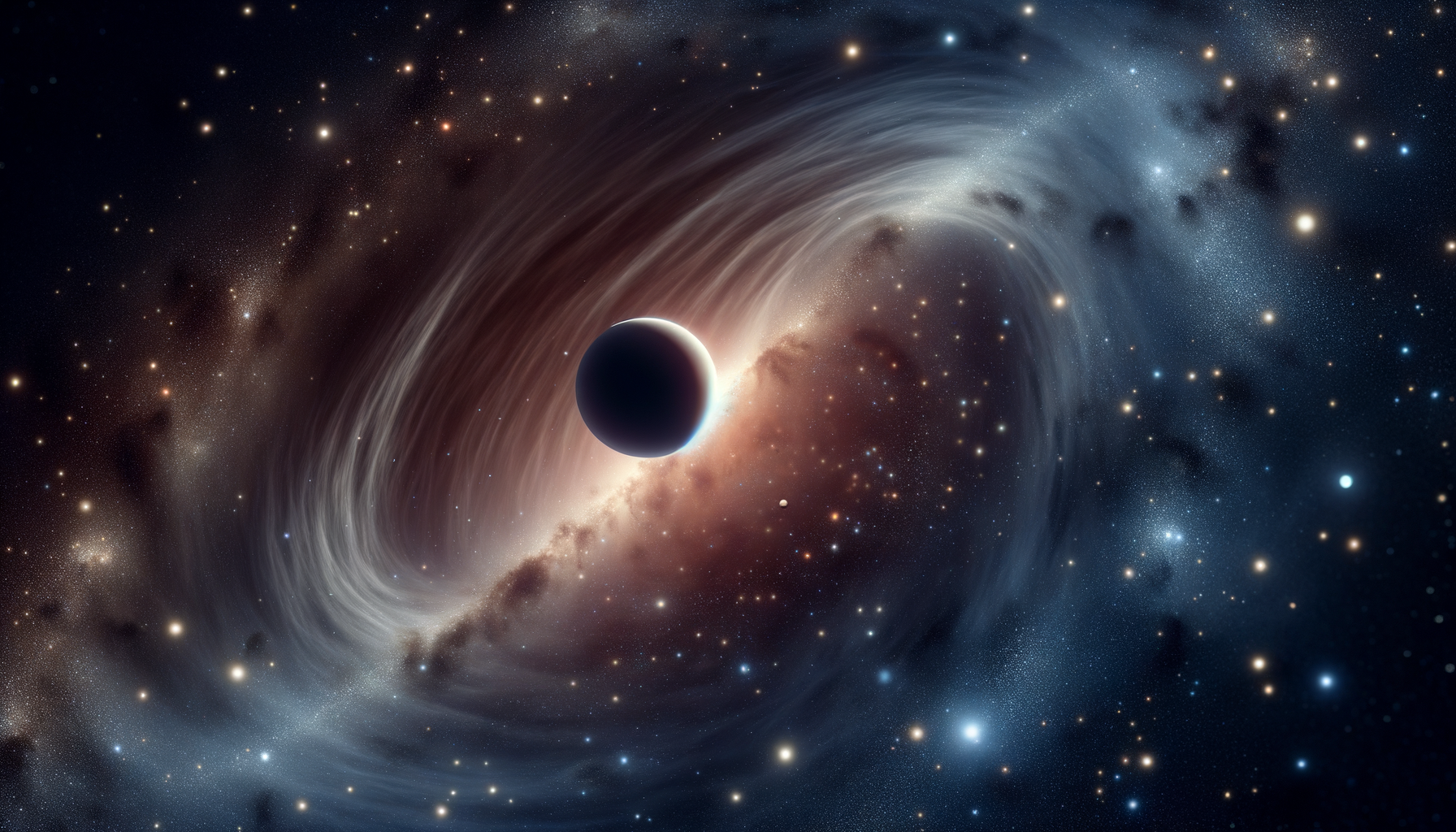

Scientists Didn’t “See” a New Planet — They Weighed It. And It’s Drifting Starless, 10,000 Light‑Years Away.
Short answer: Yes, a new free‑floating “rogue” planet was confirmed. It’s about 22% the mass of Jupiter (roughly Saturn‑mass) and around 10,000 light‑years from Earth. No, it’s not “heading for the galactic center,” and no one measured its size.
Read on for what’s real, what’s hype, and the detective work that caught a dark world that doesn’t shine.
The Big Reveal
-
Verified: Astronomers have confirmed a starless planet via gravitational microlensing — the event labeled KMT‑2024‑BLG‑0792/OGLE‑2024‑BLG‑0516 — and measured both its mass and distance by combining ground surveys with the European Space Agency’s Gaia data. It weighs in at ~0.22 Jupiter masses and sits ~10,000 light‑years away. Source: the peer‑reviewed paper published Jan 1, 2026 in Science and matched by university/science‑press summaries.
Link: https://pubmed.ncbi.nlm.nih.gov/41477875/ -
Why that’s cool: Rogue planets don’t glow. You can’t photograph them like a bright exoplanet or a nearby world. Catching one — and actually weighing it — is rare, because the “signal” is a fleeting brightening of a background star that can last only hours or days.
How They Caught A Planet That Doesn’t Shine
Think of space as a stage with a distant star as the spotlight. When a compact object (like a planet) slips between us and that star, gravity bends the star’s light — not like a prism, but by curving spacetime itself — causing a brief, tell‑tale brightening. That’s gravitational microlensing.
- Ground‑based surveys (KMTNet, OGLE) watch crowded star fields, especially toward the Galactic bulge, to spot these split‑second cues.
- Gaia, a space observatory that measures star positions incredibly precisely, helps break the usual mass–distance ambiguity in microlensing. This is how researchers nailed both the mass and the roughly 10,000‑light‑year distance.
NASA explainer on microlensing: https://www.nasa.gov/missions/roman-space-telescope/new-study-reveals-nasas-roman-could-find-400-earth-mass-rogue-planets/
The chase is intense: observers must pounce as the brightening begins, pile on data from multiple telescopes, and then model the signal fast — because once the alignment passes, the planet vanishes into darkness again.
What The Original Story Got Wrong — And What’s Right
-
Wrong: “22% the size of Jupiter.”
Correction: It’s ~22% the mass of Jupiter (about Saturn’s mass). Microlensing doesn’t directly measure a planet’s physical size (radius).
Sources: Science paper; corroborated by Space.com coverage
https://www.space.com/astronomy/exoplanets/astronomers-detect-rare-free-floating-exoplanet-10-000-light-years-from-earth -
Wrong: Light was “refracted.”
Correction: Gravity bends light by curving spacetime; there’s no glass‑like medium involved.
NASA explainer: https://www.nasa.gov/missions/roman-space-telescope/new-study-reveals-nasas-roman-could-find-400-earth-mass-rogue-planets/ -
Wrong: “No centre of gravity.”
Correction: Rogue planets absolutely have gravity and are gravitationally bound to the Milky Way. They simply aren’t bound to a host star. -
Unsupported: “Heading towards the centre of our galaxy.”
Correction: Microlensing reveals mass and distance from its light‑bending signature; it does not reliably give a 3‑D trajectory like “heading toward” anything. No such claim appears in the discovery paper. -
Misleading: “Dozens right next to us.”
Context: Most microlensing finds are thousands of light‑years away toward the Galactic bulge. Separate surveys of young clusters have indeed found dozens of massive, free‑floating objects, but “right next to us” is an exaggeration. -
Reasonable: “Researchers raced before it disappeared.”
True. Microlensing events are brief; timing is everything. -
Reasonable (with nuance): “Many rogue planets exist; first spotted in 2001.”
Close. The first widely cited free‑floating planetary‑mass objects were reported around 2000–2002 in young clusters, and estimates suggest billions or more in the Milky Way.
Overview: https://en.wikipedia.org/wiki/Rogue_planet -
Context about 3I/ATLAS: The interstellar comet 3I/ATLAS (discovered 2025) is real, but suggestions it was an alien craft were fringe; mainstream science treats it as a natural comet.
NASA profile: https://science.nasa.gov/solar-system/comets/3i-atlas/
What We Know, What We Infer, What’s Still Unclear
-
Verified facts
- A free‑floating planet detected by microlensing: event KMT‑2024‑BLG‑0792/OGLE‑2024‑BLG‑0516.
- Mass ≈ 0.22 Jupiter masses; distance ≈ 10,000 light‑years.
- Measurement achieved by combining ground surveys with Gaia data.
- The Milky Way likely hosts very large numbers of such objects.
Sources: Science paper; Phys.org summary
https://phys.org/news/2026-01-astronomers-mass-distance-rogue-planet.html
-
Well‑supported interpretations
- The planet probably formed in a protoplanetary disk and was later ejected — a leading pathway for rogues.
Science paper: https://pubmed.ncbi.nlm.nih.gov/41477875/
- The planet probably formed in a protoplanetary disk and was later ejected — a leading pathway for rogues.
-
Uncertainties / not established
- Its physical size (radius), composition, atmosphere, temperature — microlensing alone can’t tell us.
- Its trajectory in detail; claims about heading toward the Galactic center are unsupported.
Why This One Matters
- It’s a clean demonstration that we can not only catch a dark, starless planet in the act of lensing — we can also weigh it and place it in the Galaxy. That’s a leap from “there’s something there” to “here’s how massive and how far.”
- It previews what NASA’s Nancy Grace Roman Space Telescope could do in bulk: find and weigh hundreds of rogue planets, including smaller ones, by running a precision microlensing survey.
NASA on Roman’s rogue planet potential: https://www.nasa.gov/missions/roman-space-telescope/new-study-reveals-nasas-roman-could-find-400-earth-mass-rogue-planets/
A Simple Picture: How Microlensing Outsmarts the Dark
- If a planet passes in front of a background star, its gravity briefly brightens that star — a cosmic “magnifying glass.”
- The shape and timing of that brightening encode the lens’s mass and relative motion.
- With added astrometric data (Gaia), scientists can separate mass from distance, turning a mysterious blip into a weighed world.
Our Reporting Process
We read the peer‑reviewed Science paper (via PubMed), then cross‑checked with NASA explainers and independent coverage from Phys.org and Space.com. We compared each claim in the original article against these sources, flagging what’s verified, what’s misleading, and what remains unknown.
Key sources:
- Science paper (PubMed): https://pubmed.ncbi.nlm.nih.gov/41477875/
- NASA on microlensing and rogue planets: https://www.nasa.gov/missions/roman-space-telescope/new-study-reveals-nasas-roman-could-find-400-earth-mass-rogue-planets/
- Phys.org summary: https://phys.org/news/2026-01-astronomers-mass-distance-rogue-planet.html
- Space.com coverage: https://www.space.com/astronomy/exoplanets/astronomers-detect-rare-free-floating-exoplanet-10-000-light-years-from-earth
- Rogue planet background: https://en.wikipedia.org/wiki/Rogue_planet
- NASA on interstellar comet 3I/ATLAS: https://science.nasa.gov/solar-system/comets/3i-atlas/
Bottom line: A rare, well‑weighed rogue planet just slipped through our sights. It’s not on a collision course, it’s not glowing, and it’s not “22% the size of Jupiter.” It’s a Saturn‑mass loner, drifting in the dark — and exactly the kind of ghost world we’re finally learning to count.