
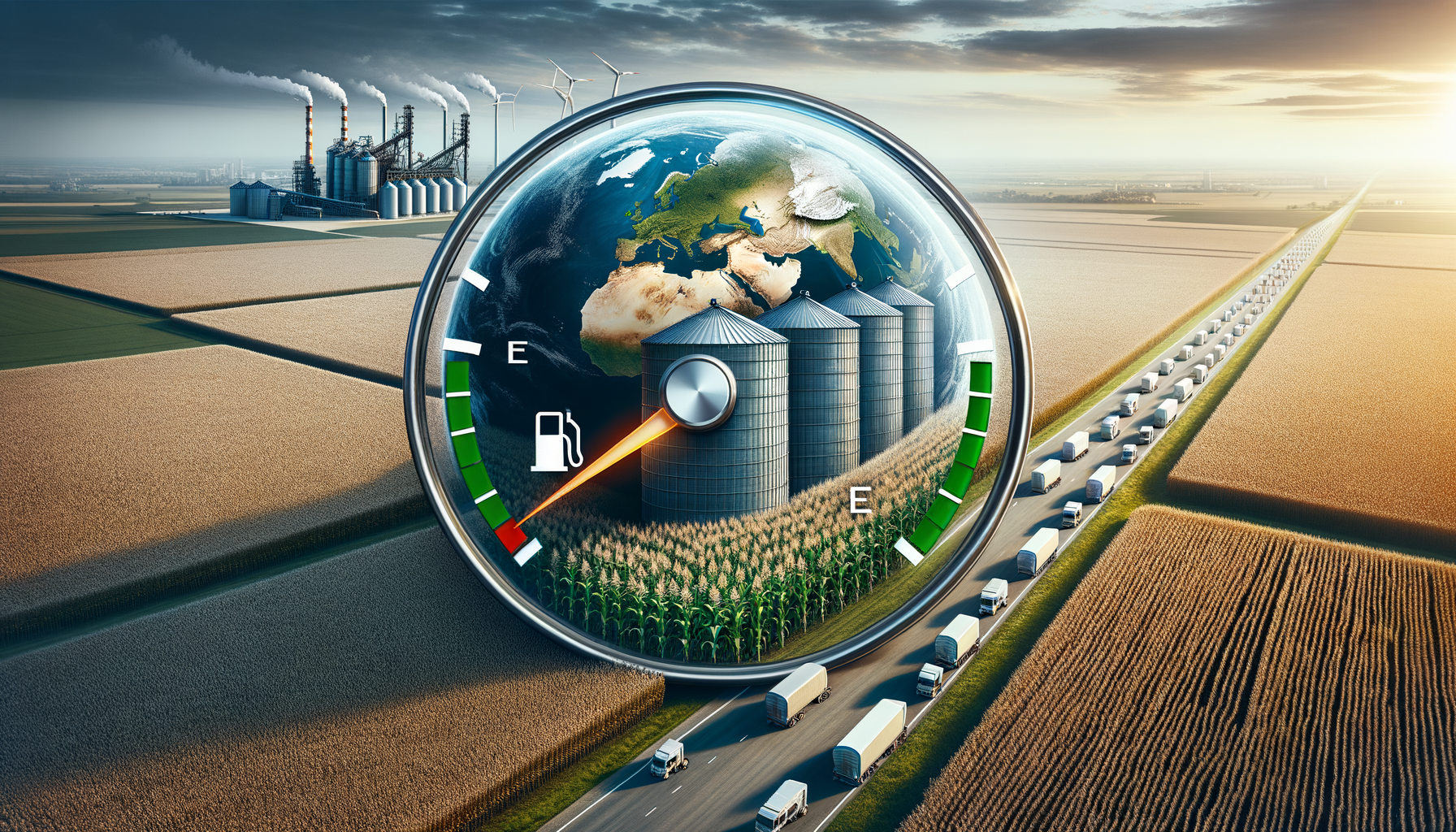

Europe’s “Biggest Maize Mountain”? Not Quite — And It Won’t Fuel 900 Trips Around the World
Short answer: No. The maize pile at Brokenlande is impressive, but current evidence points to about 49,000 tons harvested — not 70,000 — and the energy would power roughly 375–550 laps around Earth, not 900. The site also doesn’t appear to dispense biomethane to trucks at the A7 as claimed. Here’s what really holds up — and what doesn’t.
The Eye‑Catcher vs. The Evidence
Let’s start with the most surprising correction: the headline‑making “70,000 tons” and “largest in Europe” claims don’t check out. What is solid is still remarkable: two forage harvester chains brought in about 49,000 tons of silage maize in just ten days for ARA Biogas Brokenlande in Schleswig‑Holstein. That’s a monster harvest — just not the 70,000‑ton mountain billed as a European one‑off.
- Verified: About 49,000 tons in 10 days in 2025 at ARA Biogas Brokenlande. Source: Top agrar report https://www.topagrar.com/panorama/news/49000-tonnen-mais-im-xxl-silo-20019934.html
- Unverified: “70,000 tons now stored here” for this specific site and season. No independent source confirms this larger figure.
- Not supported: “Largest in Europe.” No evidence of a continent‑wide superlative.
Also, the story calls the harvesters “Mähdrescher” (grain combines). That’s simply wrong for silage maize. These were forage harvesters (Häcksler) — the machines that chop whole plants for silage.
- Source: Top agrar https://www.topagrar.com/panorama/news/49000-tonnen-mais-im-xxl-silo-20019934.html
Where This Mountain Actually Sits — And Who Runs It
The site is real and traceable: ARA Biogas Brokenlande GmbH & Co. KG, in the Großenaspe municipality (district Brokenlande), managed by Christian Saul. The article’s “Brokenfelde” looks like a typo.
- Source: ARA Biogas https://en.ara-biogas.com/
Fuel for 900 Earth Loops? Let’s Do the Math
The article claims the pile could power a truck for “35 million km” — almost 900 times around the globe. That figure is unsubstantiated and optimistic.
- ARA’s own yield figure: 1 ton silage ≈ 1,100 kWh equivalent green energy (via biogas). Source: ARA https://en.ara-biogas.com/
- If the pile were truly 70,000 t: 70,000 × 1,100 kWh ≈ 77 GWh
- If we use the documented 49,000 t: 49,000 × 1,100 kWh ≈ 54 GWh
Real‑world gas truck energy use is roughly 25 kg methane per 100 km. With 13.9 kWh/kg, that’s about 3.5 kWh per km. Sources: industry consumption example https://translogistiknews.de/news/was-bringt-ein-erdgas-antrieb-lng-lkw-statt-dieselfahrzeuge-fuer-die-logistik/
- With 77 GWh: ≈ 22 million km (about 550 times around Earth)
- With 54 GWh: ≈ 15 million km (about 375 times around Earth)
So the “35 million km” (≈900 laps) needs far lower energy use per km than typical heavy trucks achieve. It’s an optimistic, not a documented, estimate.
Does This Biogas Fuel Trucks at the A7?
The article paints a vivid picture: maize in, biomethane out, trucks refueled at the site by the A7. But public listings and the operator’s site tell a different story.
- ARA emphasizes electricity and heat from CHP, and “provision of charging current,” not a public biomethane pump. Source: ARA https://en.ara-biogas.com/
- At the A7 rest area “Brokenlande Ost/West” you’ll find conventional fuels and high‑power EV chargers (Ionity), not advertised CNG/LNG biomethane dispensers.
- Serways rest area page: https://www.serways.de/standorte/brokenlande-ost/
- Ionity listings via Electromaps (example): https://www.electromaps.com/de/ladestationen/deutschland/schleswig-holstein/groenaspe/ionity-brokenlande-ost-apothekerholz
In short: the site appears to help supply electricity, not run a public bio‑CNG/LNG pump for trucks on the A7.
“E‑Tankstelle for 15 Cars and Trucks” — On Site?
This count doesn’t line up cleanly with public data.
- Ionity typically has four 350‑kW stalls on each side of the A7 rest area (≈8 total).
- Nearby, there are additional public chargers in Großenaspe — e.g., a GP JOULE Connect site with two 150‑kW CCS connectors and other points listed under GES Energie — but they’re not clearly “on ARA’s premises.”
Conclusion: “15 on‑site” is unverified/likely overstated.
How Big Is the Pile, Physically?
The article cites a base of 100 m × 100 m and a height of at least 15 m. Similar heights exist at other sites (16 m piles are known), so it’s plausible. But for Brokenlande’s 2025 pile, precise dimensions weren’t independently confirmed in public sources.
- Example of a comparable 16‑m case (different site): BayWa https://www.baywa.de/de/i/beratung/mais/ernte/mais-fahren-videos/
The “about 400 parking spaces” comparison is reasonable: 10,000 m² at ~25 m² per car space (including lanes) ≈ 400.
Germany’s 2025 Silage Maize Picture
Nationally, the numbers in the article are basically right: around 1.96 million hectares and 84.2 million tons of silage maize in 2025. Calling it “average after a wet summer” is interpretation; the data itself is sound.
- Source: Deutsches Maiskomitee (DMK) https://www.maiskomitee.de/Aktuelles/Flaechenertraege-von-Silomais-gesunken
What’s Verified vs. What Needs More Proof
What we know
- Operator and location are correct: ARA Biogas Brokenlande; managing director Christian Saul. https://en.ara-biogas.com/
- 2025 harvest: ≈49,000 t in 10 days with two forage harvester chains. https://www.topagrar.com/panorama/news/49000-tonnen-mais-im-xxl-silo-20019934.html
- Energy math: 49,000–70,000 t implies ≈54–77 GWh; realistic truck range ≈15–22 million km (≈375–550 Earth laps), not 35 million km. https://en.ara-biogas.com/ https://translogistiknews.de/news/was-bringt-ein-erdgas-antrieb-lng-lkw-statt-dieselfahrzeuge-fuer-die-logistik/
Needs confirmation or is misleading
- “70,000 tons now stored here”: unverified for this site/season.
- “Largest in Europe”: not supported by independent comparisons.
- On‑site bio‑CNG/LNG fueling at the A7: no public evidence; the rest area is known for EV fast charging, not biomethane.
- “E‑Tankstelle for 15 vehicles on the premises”: charger counts nearby don’t neatly match and aren’t clearly on ARA’s property.
- “900 world tours”: requires optimistic truck consumption assumptions.
Simply incorrect
- Harvest machines called “Mähdrescher”: should be forage harvesters (“Häcksler”) for silage maize.
Unverified but plausible
- Planned power purchase from a Bürger‑Windpark: a citizen wind park exists in Großenaspe, but no direct source confirms ARA’s pending deal.
How We Checked
- Cross‑checked the site and operator on ARA’s official page: https://en.ara-biogas.com/
- Verified the harvest tonnage and machinery in Top agrar’s field report: https://www.topagrar.com/panorama/news/49000-tonnen-mais-im-xxl-silo-20019934.html
- Reviewed national maize figures from the German Maize Committee: https://www.maiskomitee.de/Aktuelles/Flaechenertraege-von-Silomais-gesunken
- Checked the A7 rest area and charging infrastructure listings: https://www.serways.de/standorte/brokenlande-ost/ https://www.electromaps.com/de/ladestationen/deutschland/schleswig-holstein/groenaspe/ionity-brokenlande-ost-apothekerholz
- Used industry consumption data for LNG/CNG trucks: https://translogistiknews.de/news/was-bringt-ein-erdgas-antrieb-lng-lkw-statt-dieselfahrzeuge-fuer-die-logistik/
Bottom Line
- The maize mound at Brokenlande is big — just not the biggest in Europe, and not clearly 70,000 tons this season.
- The energy is substantial, but closer to 15–22 million km for a heavy truck fleet under realistic assumptions — not 35 million.
- The site appears to be more about biogas‑to‑electricity than on‑site biomethane truck fueling at the A7.
It’s a genuine feat of modern agriculture and energy — and still a good story — once the hype is peeled back to the facts.