
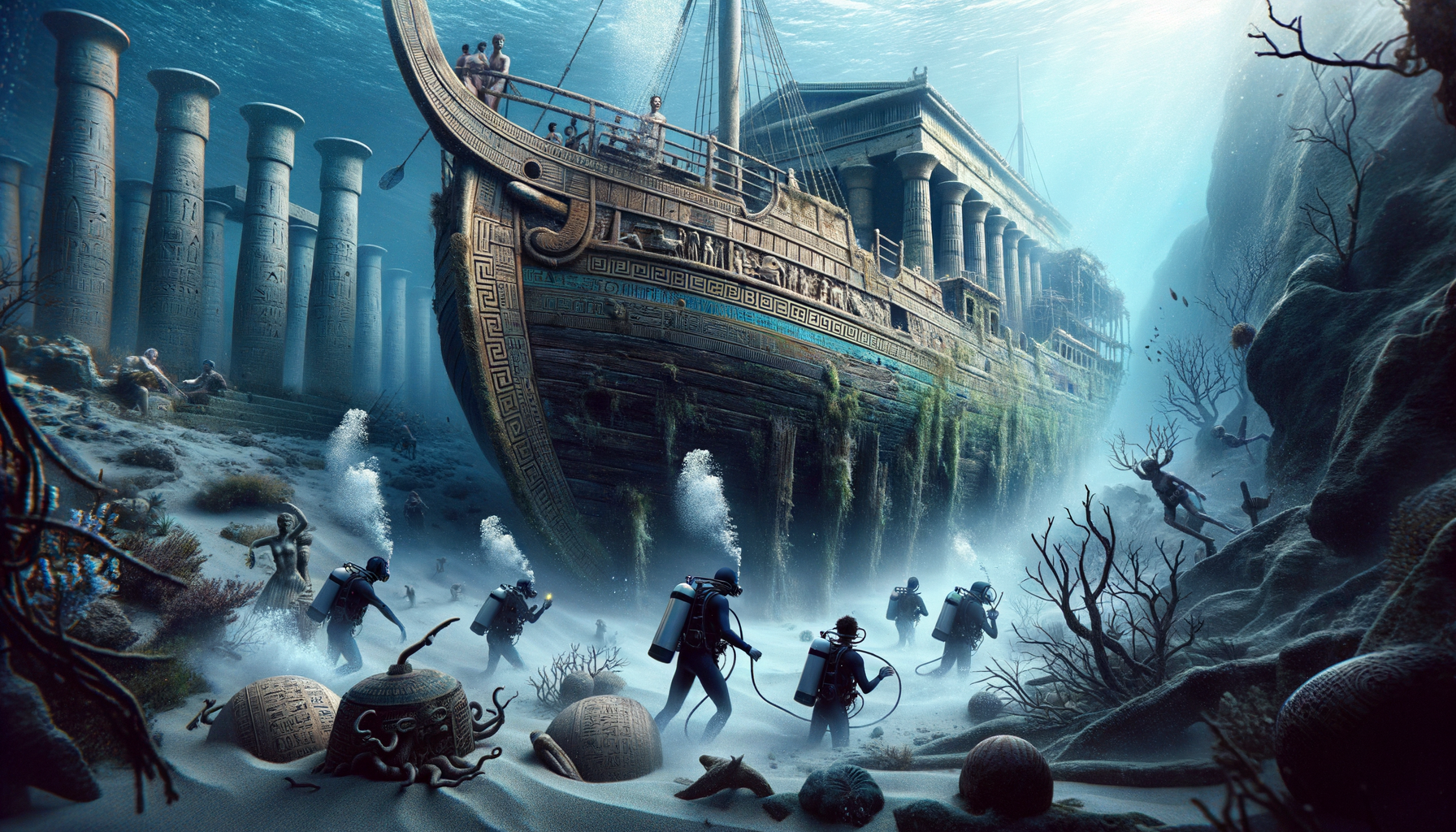

Divers really did find a 2,000‑year‑old “party boat” off Alexandria — but some of the splashiest claims need careful untangling. The ship is real, the luxury is real, and the Greek graffiti is real. The dramatic “tsunami swallowed the coast in AD 50” bit? That’s a strong hypothesis for this wreck’s fate near a temple — not proof of a region‑wide cataclysm.
The deeper story is even better.
Headline: Egypt’s “Ancient Party Boat” Is Real. Here’s What We Know — and What’s Still Guesswork.
The revelation that changes the story The biggest correction isn’t about treasure; it’s about time. Many outlets imply that several earthquakes and tidal waves wiped out large parts of Egypt’s coast around AD 50, taking the vessel with them. What experts actually say is narrower: the team that found the wreck believes it may have gone down when a nearby Isis temple collapsed around AD 50. The famous regional destruction of Alexandria’s royal quarter comes much later — after the massive AD 365 Crete earthquake and tsunami.
- IEASM’s leading hypothesis: local temple collapse around AD 50 may explain the wreck’s burial. Source: IEASM project page (Franck Goddio) https://www.franckgoddio.org/shipwreck-k1/
- The big coastal disaster most people think of: AD 365 tsunami. Source: Wikipedia overview (with references) https://en.wikipedia.org/wiki/365_Crete_earthquake?utm_source=openai
What divers actually found (and why it matters) Picture this: seven meters under the Mediterranean, beneath a blanket of about 1.5 meters of sediment, a long, low hull lies within a stone’s throw of the sunken royal island of Antirhodos — the palace zone of ancient Alexandria. The team from the Institut Européen d’Archéologie Sous‑Marine (IEASM) — not “EIASM,” as some reports have it — uncovered timbers from a first‑century pleasure barge known in Greek as a thalamagos (or thalamegos). Think ancient superyacht, all cabins and comfort, powered by oars.
Key verified facts
- Location: Found in the port area of Antirhodos, off Alexandria, Egypt. Source: IEASM (Franck Goddio) https://www.franckgoddio.org/shipwreck-k1/
- Depth and burial: About 7 m of water, covered by roughly 1.5 m of sediment. Source: Euronews summary https://www.euronews.com/culture/2025/12/09/archaeologists-find-2000-year-old-party-boat-off-alexandria?utm_source=openai
- Dimensions: 28 m of preserved timbers point to an original length around 35 m and a breadth around 7 m. Source: IEASM https://www.franckgoddio.org/shipwreck-k1/
- Inscriptions and date: Greek graffiti on the central carling (a longitudinal beam) date to the first half of the 1st century AD. Source: IEASM https://www.franckgoddio.org/shipwreck-k1/
- Design and use: A luxury cabin boat, likely oar‑propelled — a floating lounge for royal‑court excursions. Source: IEASM https://www.franckgoddio.org/shipwreck-k1/
- Proximity: Very close to the temple of Isis excavation — often described as “less than 50 m.” Source: IEASM https://www.franckgoddio.org/shipwreck-k1/
The party was not a modern invention Strabo, the Greek geographer who visited Egypt around the turn of the era, describes cabin‑boats and canal revelry with music and dancing — pretty much the ancient version of a nightlife cruise. That tracks perfectly with a luxury thalamagos hosting feasts on Alexandria’s waters. Source: Strabo, Book 17 (English translation) https://penelope.uchicago.edu/Thayer/E/Roman/Texts/Strabo/17A2%2A.html?utm_source=openai
Where the story gets slippery (and how to read it)
- The “tsunami in AD 50” claim
- What’s solid: IEASM’s team proposes the wreck sank when the nearby Isis temple collapsed around AD 50. That explains why the boat lies so close, deeply buried, and in a destruction layer.
- What’s not: Expanding that local event into “several earthquakes and tidal waves destroyed large parts of the coast” at that time is not well‑supported. The major, well‑documented coastal submergence is tied to the AD 365 tsunami. Sources: IEASM https://www.franckgoddio.org/shipwreck-k1/ and 365 event overview https://en.wikipedia.org/wiki/365_Crete_earthquake?utm_source=openai
- The ship’s size
- Most sources — including the primary research team — give about 35 m by 7 m. One notable outlier report mentions 23 m. Given the preserved timbers (28 m) and IEASM’s reconstruction, the c. 35 m estimate is the best‑supported figure. Source: IEASM https://www.franckgoddio.org/shipwreck-k1/
- The “keel” inscription
- Correction: The graffiti were recorded on the central carling, not literally on the keel beam. It’s a technical point, but it matters to shipwrights and historians. Source: IEASM https://www.franckgoddio.org/shipwreck-k1/
- Cleopatra’s yacht tours with Julius Caesar
- Ptolemaic “floating palaces” absolutely existed. But the specific image of Cleopatra showing Caesar the sights on one of these vessels is best treated as popular tradition, not a firmly documented event. And the most famous “barge” scene in culture is Shakespeare’s Antony and Cleopatra — with Antony, not Caesar. Sources: IEASM on luxury barges https://www.franckgoddio.org/shipwreck-k1/, context on the Shakespeare trope https://www.rsc.org.uk/antony-and-cleopatra/about-the-play/dates-and-sources?utm_source=openai, classroom guide on Cleopatra traditions https://warwick.ac.uk/fac/arts/classics/warwickclassicsnetwork/stoa/anchist/gcse/cleopatra/teachersguide?utm_source=openai
- The institute’s name
- It’s IEASM (from the French name), not “EIASM.” Source: IEASM homepage https://www.franckgoddio.org/
A short tour through time: Alexandria’s stage At the time this barge sailed, Alexandria was the jeweled capital of Egypt: royal palaces on Antirhodos, grand temples, and the Lighthouse of Pharos — often estimated around 100–130 m high and counted among the Seven Wonders. The setting suits a pleasure craft designed for spectacle. Source: Britannica on the lighthouse https://www.britannica.com/topic/lighthouse-of-Alexandria?utm_source=openai
How we checked the claims
- We started with the discoverers’ own write‑up and diagrams to anchor basic facts: location, measurements, structure, and dating.
- We cross‑referenced multiple news reports for depth and sediment data, which are consistent across several outlets.
- We separated hard evidence (timbers, graffiti, findspot) from interpretations (temple collapse timing, cause of sinking).
- We traced colorful historical references back to ancient texts (Strabo) and flagged where modern retellings blur with Shakespearean lore (Cleopatra’s barge).
What’s still uncertain
- The exact moment and mechanism of the ship’s sinking remain a hypothesis built from context (near the Isis temple, destruction layers) rather than a direct, datable event. IEASM’s AD 50 scenario fits the evidence so far, but underwater archaeology often rewrites itself as more of a site is uncovered.
- Final dimensions could shift slightly as excavations continue and more of the hull is mapped.
- The vessel’s full layout and amenities — beyond a “luxury cabin” and oar propulsion — await further study.
Why this find matters Beyond the headlines, this wreck gives us a rare, physical look at elite leisure on the water in Roman‑era Alexandria. It takes the party scenes that Strabo described and pins them to real timbers, real graffiti, and a real place — within sight of a temple where gods, rulers, and rumor all mingled.
Bottom line
- Yes, a first‑century luxury barge — a thalamagos — has been found off Antirhodos, near the Isis temple.
- Its likely size is about 35 × 7 m; it lay under 1.5 m of sediment in about 7 m of water.
- Greek graffiti on a central carling dates it to the first half of the 1st century AD.
- It may have sunk during a local collapse near AD 50, but the famous region‑wide coastal devastation belongs to the AD 365 tsunami.
- Cleopatra’s “party tours” with Caesar are a story that won’t die — enjoyable, but not rock‑solid history.
If anything, the truth here is more interesting than the hype: a royal‑era lounge boat asleep under Alexandria’s waves, exactly where the ancient sources told us the music once played.